English
 简体中文
简体中文 French
 日本語
日本語 Korean
 Português
 Русский
 Spanish



NEWS
Vertical vacuum tube furnace is a specialized equipment for high-temperature treatment in a vacuum or controlled atmosphere environment. Its vertical structure design gives it many advantages in laboratory and industrial production. Let's take a detailed look at this heat treatment electric furnace below!
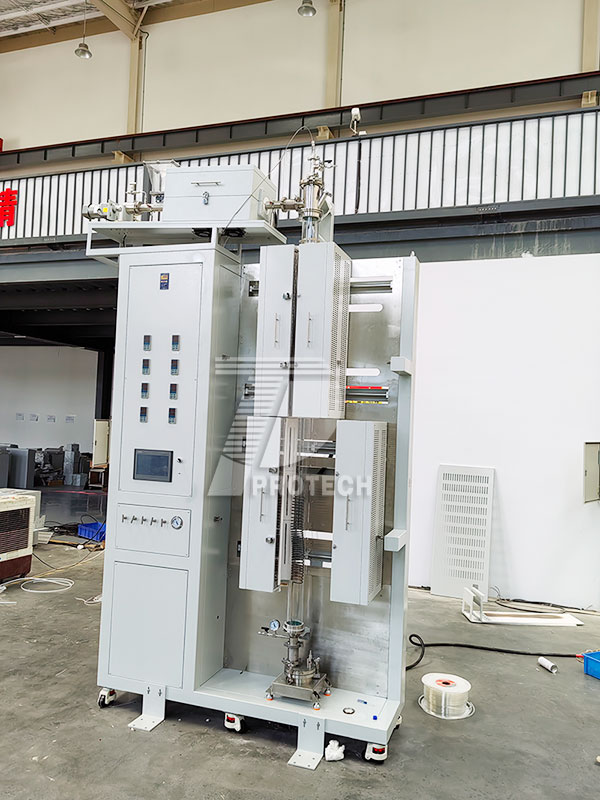
A commonly used vertical vacuum tube furnace (click on the image to view product details)
1. Core Features
Vertical structure design
The furnace body adopts a vertical layout, and the furnace tubes are placed vertically to reduce the footprint, making it suitable for laboratories or production environments with limited space.
Sample loading and removal can be done through top or bottom operations, making it easy to integrate with automated equipment such as sample propulsion systems.
Vacuum and Atmosphere Control
Equipped with mechanical pump, diffusion pump or molecular pump, the vacuum degree can reach 10 ⁻ Pa to 10 ⁻ ³ Pa, effectively preventing material oxidation.
Support precise introduction of inert gases (such as argon, nitrogen), reducing gases (such as hydrogen), or reactive gases, with controllable gas mixing ratio accuracy.
high-temperature performance
The working temperature range covers room temperature to 1700 ℃, and the commonly used temperature range is 900 ℃ to 1600 ℃.
The furnace tube material can be selected from quartz tube (≤ 1100 ℃), corundum tube (≤ 1600 ℃) or metal tube to meet different process requirements.
modular design
Furnace tubes, heating elements, vacuum systems and other components support quick replacement and are compatible with multi temperature zone control (such as dual temperature zone and triple temperature zone), meeting complex heat treatment requirements.
2. Technical advantages
temperature uniformity
Adopting a PID intelligent temperature control system, combined with high-precision thermocouples, the temperature accuracy reaches ± 1 ℃, and the fluctuation in the constant temperature zone can be controlled within ± 5 ℃.
Heating elements (such as silicon carbon rods and silicon molybdenum rods) are evenly distributed and combined with lightweight alumina ceramic fiber furnaces to reduce heat loss and improve energy efficiency.
Energy conservation and environmental protection
The double-layer shell structure (inner layer of ceramic fiber, outer layer of cold-rolled steel plate) is filled with aluminum silicate fiber insulation layer. When the furnace is heated to 1100 ℃, the power consumption is lower, and the surface temperature is ≤ 50 ℃.
Flanges can support water-cooled structures, which are safer and more energy-efficient.
safety protection
Integrate over temperature protection, over temperature protection, thermocouple protection, leakage protection, gas pressure monitoring, and emergency shutdown mechanism to ensure safe operation.
Automatically cut off the heating power when the furnace door is opened to prevent accidents.
intelligent operation
Support 30 programmable temperature control programs to achieve automatic control of multi-stage heating, insulation, and cooling.
Optional RS-485 serial port, touch screen or IoT module for remote monitoring and data acquisition.
3. Application Fields
Materials Science
Ceramic sintering: Improving the density, hardness, and strength of ceramic products (such as ceramic tiles and ceramic vessels).
Metal heat treatment: processes such as quenching, annealing, and tempering improve the mechanical properties of metals (such as heat treatment of aircraft engine casings).
Nanomaterial preparation: synthesis of high-temperature superconducting materials, composite materials, etc. under vacuum or inert atmosphere.
Semiconductors and Electronics
Crystal growth: such as silicon wafer annealing and gallium nitride CVD growth.
Thin film deposition: Preparation of silicon thin films, metal thin films, etc. through CVD, PECVD processes.
Device annealing: optimizing the performance of semiconductor devices (such as solar panel manufacturing).
new energy sector
Preparation of lithium battery materials: sintering of positive and negative electrode materials of high nickel ternary materials, lithium iron phosphate, and lithium cobalt oxide.
Solid state electrolyte synthesis: Preparation of high-performance solid electrolytes in a vacuum environment.
Battery recycling: The regeneration and utilization of waste battery materials are achieved through high-temperature pyrolysis.
Chemical synthesis and catalysis
Catalyst preparation: sintering, activation, and high-temperature reaction research of catalysts.
Compound synthesis: Synthesis of catalytic materials, compound semiconductors, etc. under controlled atmosphere.
Research and Laboratory
Elemental analysis: a high-temperature experimental platform for chemical, physical, and biomedical materials.
Small steel processing: such as quenching and annealing experiments in university teaching laboratories.
4. Selection suggestions
Temperature requirements
If dealing with ultra-high temperature materials (such as 1600 ℃), choose equipment with silicon molybdenum rod heating elements.
Conventional high-temperature treatment (≤ 1400 ℃) can use corundum tube furnace type.
Vacuum requirement
High vacuum requirements (such as semiconductor processes) require the configuration of a molecular pump, with a vacuum degree of up to 10 ⁻³ Pa.
For general vacuum or atmosphere protection scenarios, a combination of mechanical pump and diffusion pump is sufficient.
atmosphere control
If you need to better control the gas ratio (such as CVD process), choose equipment equipped with a mass flow controller (MFC).
Simple inert gas protection scenario, optional basic gas inlet system.
size
Select furnace tube specifications based on sample size (common outer diameters: Φ 50mm, Φ 60mm, Φ 80mm).
Choose the length of the furnace tube as needed, commonly ranging from 1000mm to 3000mm.
Brand and after-sales service
It is recommended to choose manufacturers with non-standard customization capabilities, who can provide specialized furnace types or complex process integration solutions.
Priority should be given to brands that provide complete after-sales service, including equipment installation and debugging, operation training, and technical support.Click to learn more vertical tube furnaces! Or click on online customer service to learn more about product information!
Leave A Message