
 English
 简体中文
简体中文 French
 日本語
日本語 Korean
 Português
 Русский
 Spanish



NEWS
CVD tube furnace can be designed with a solid structure, which has great advantages in specific application scenarios, but it needs to be comprehensively evaluated based on process requirements, equipment costs, and operational convenience. Let's take a detailed look below!
1. Feasibility of Vertical CVD Tube Furnace
structural adaptability
The core of CVD tube furnace is the tube reaction chamber, which is essentially a long tubular container that can accommodate substrates and achieve gas flow inside. The vertical structure can achieve the same chemical vapor deposition function as a horizontal furnace by placing the reaction tube vertically, utilizing gravity assisted airflow distribution, and optimizing the layout of the heating system (such as surround heating or bottom heating).
Technical Implementation Case
Mature products of vertical CVD tube furnaces already exist in the market, such as:
Vertical PECVD (Plasma Enhanced CVD) equipment: By designing a vertical reaction chamber and combining it with a plasma source, efficient thin film deposition is achieved, which is widely used in fields such as solar cells and display panels.
Vertical LPCVD (Low Pressure CVD) equipment: In low-pressure environments, vertical layout can reduce gas turbulence and improve film uniformity, making it suitable for semiconductor device manufacturing.
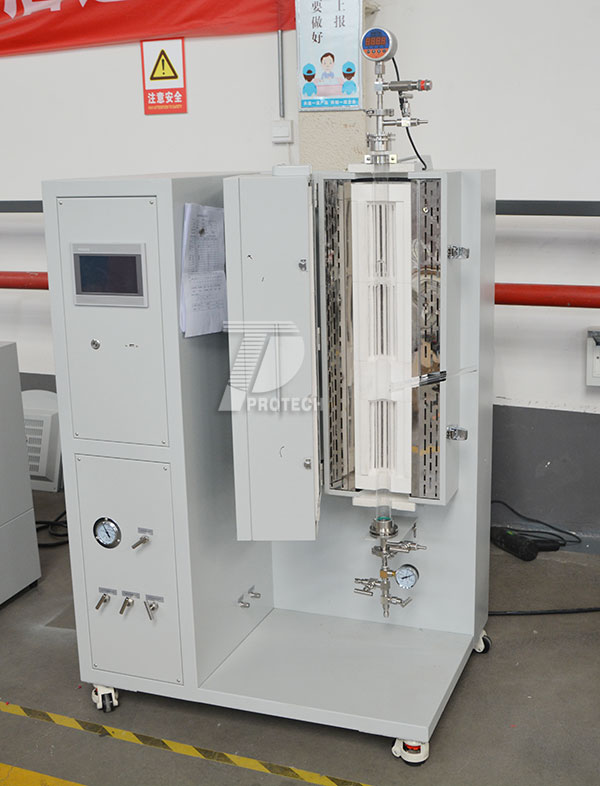
A commonly used vertical CVD coating electric furnace (click on the image to view product details)
2. Advantages of Vertical Structure
Optimization of airflow distribution
The vertical airflow path is shorter, which can reduce the residence time of gas in the reaction tube and lower the probability of side reactions, especially suitable for processes that require high gas purity (such as deposition of high-k media).
Improved temperature uniformity
In a vertical structure, heating elements can be evenly distributed around the reaction tube, reducing temperature gradients and avoiding deformation or uneven film stress caused by local overheating of the substrate.
Improved space utilization
Vertical layout can save space in laboratories or production lines, making it suitable for space constrained scenarios such as cleanrooms and pilot lines.
Adapt to special process requirements
Liquid precursor deposition: The vertical structure facilitates precise dropwise addition of liquid sources (such as TEOS), avoiding uneven source distribution caused by gravity in horizontal furnaces.
3D substrate processing: The vertical reaction chamber can accommodate cylindrical or irregular substrates, achieving uniform deposition in all directions.
3. Prioritize vertical structure scenarios
High purity and uniformity thin films (such as semiconductor gate oxide layers) are required.
Process liquid phase precursors or 3D substrates.
Space is limited and requires efficient use of vertical space.Click to learn more CVD devices! Or click on online customer service to learn more about product information!
Leave A Message


