English
 简体中文
简体中文 French
 日本語
日本語 Korean
 Português
 Русский
 Spanish



NEWS
PECVD tube furnace can be designed as a rotating structure, and the rotating function has great advantages in improving the quality, uniformity, and process flexibility of thin film deposition. Let's take a detailed look below!
Feasibility of Rotating Design
technical implementation
The rotating PECVD tube furnace achieves 360 ° continuous rotation or specific angle tilting of the furnace tube by integrating a rotating mechanism (such as motor drive, magnetic fluid seal, etc.) on the furnace body or tube. For example:
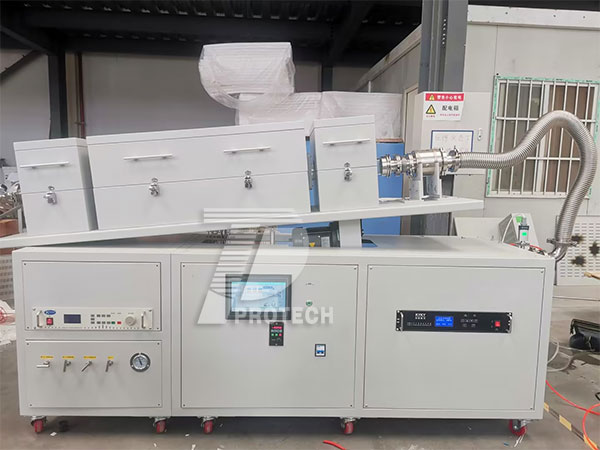
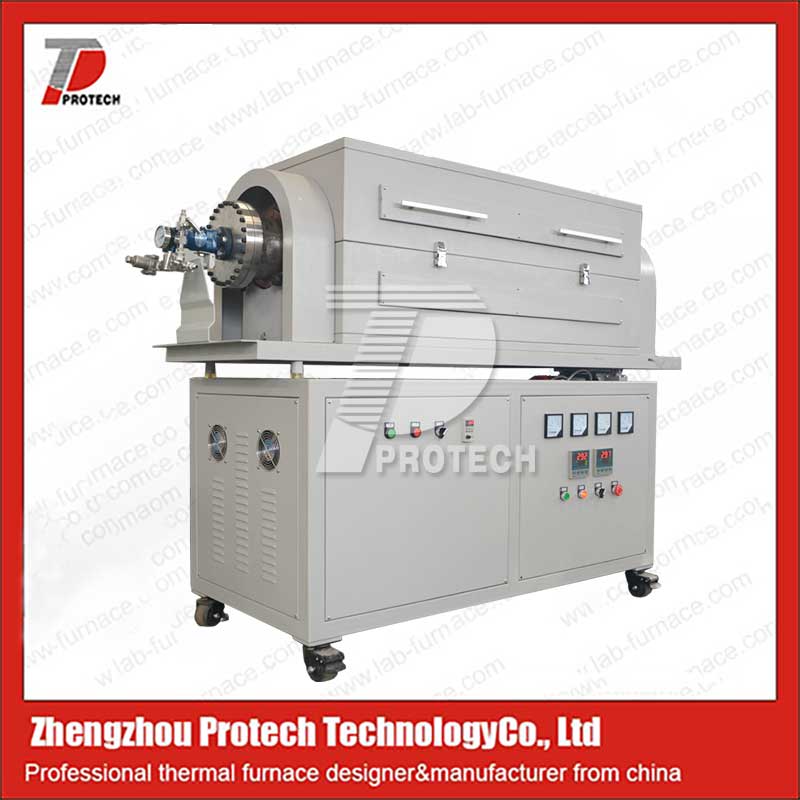
PT-TPECVD1100-S80CK3: The furnace tube can rotate 360 °, with an adjustable speed of 1-20 revolutions per minute. The inner wall of the tube is equipped with quartz blocking plates to assist in powder flipping and improve sintering uniformity.
Customized Rotating PECVD System: Equipped with variable diameter furnace tubes and quartz feeding platforms on the inner walls, the rotation speed can be adjusted to meet different material deposition requirements.
Structural adaptability
The rotation function needs to be designed in conjunction with modules such as vacuum system, gas supply, and RF power supply. For example:
Sealing technology: Adopting double ring sealing or magnetic fluid sealing to ensure stable vacuum degree during rotation (maximum vacuum can reach 10 ⁻ Pa).
Gas control: The flow rate of the reaction gas is effectively controlled through a multi-channel mass flow meter (MFC) to avoid turbulence caused by rotation.
Advantages of Rotating Design
Improve film uniformity
Rotation ensures full contact between the material, plasma, and reaction gas, eliminating local deposition differences. For example:
When depositing silicon nitride (Si ∝ N ₄) or silicon oxide (SiO ₂) thin films, rotation can reduce defects such as pinholes and cracks, improve film density and adhesion.
For non planar substrates (such as spherical or fibrous), rotation ensures uniform plasma coverage and avoids edge effects.
Optimize process parameters
Temperature control: Rotation promotes uniform distribution of temperature field inside the furnace, avoiding local overheating or underheating, and is more suitable for high-temperature processes (such as the extreme temperature of 1200 ℃).
Gas utilization rate: Rotating prolongs the residence time of gas in the reaction zone, improves reaction efficiency, and reduces gas consumption.
Expand application scenarios
Composite film deposition: alternate deposition of multi-layer films through rotation, such as preparing gradient functional materials.
Powder material processing: Rotate to fully disperse the powder in the plasma, suitable for nanoparticle coating or doping.
Practical application cases
PT-TPECVD1100-S80CK3
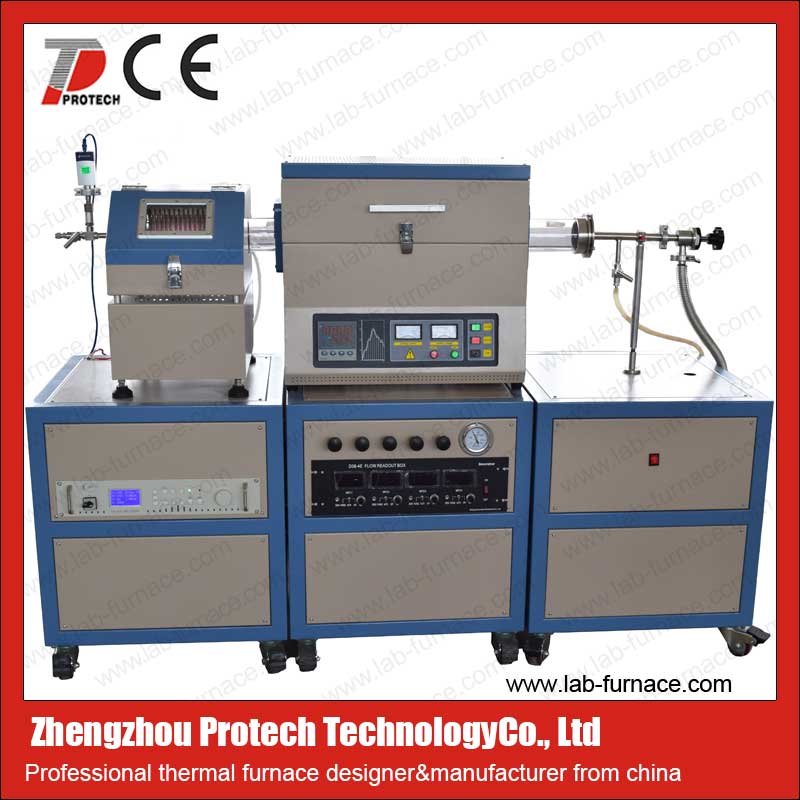
Configuration: Vacuum rotary tube furnace, quartz vacuum chamber, RF power supply, gas supply system, exhaust system.
Features: The furnace tube rotates 360 ° and the tilt angle is adjustable from -10 ° to 30 °, suitable for powder sintering or thin film deposition.
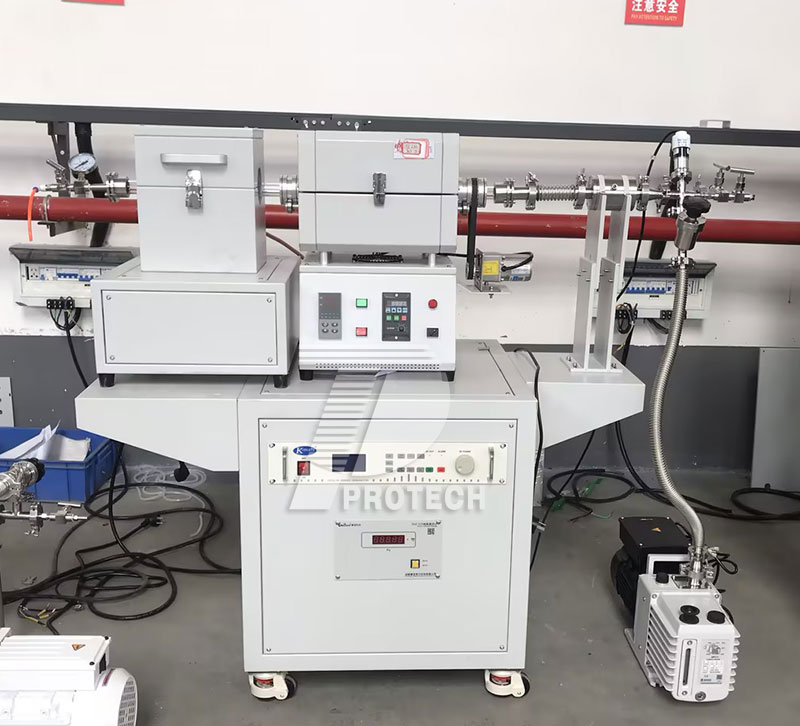
Customized Rotating PECVD System (PT-TX1100-S50LK1)
Configuration: Plasma RF power supply, high-temperature mini tube furnace, rotary vane vacuum pump unit.
Features: The furnace tube rotates 360 °, with adjustable rotation speed and a vacuum degree of up to 10 ⁻ Pa, suitable for high-precision thin film deposition.Click to learn more PECVD devices! Or click on online customer service to learn more about product information!
Leave A Message