
 English
 简体中文
简体中文 French
 日本語
日本語 Korean
 Português
 Русский
 Spanish



NEWS
In the fields of new material development and powder calcination heat treatment, traditional static tube furnaces and box furnaces often encounter problems such as uneven heating, powder agglomeration, and poor batch stability when processing powder materials. As a dynamic heat treatment equipment, the rotary tube furnace (rotary tube furnace) relies on the adjustable structure of furnace tube rotation and tilt to achieve dynamic sintering and continuous heat treatment of powder materials. It has been widely used in laboratory small-scale, pilot scale, and industrial continuous production scenarios.

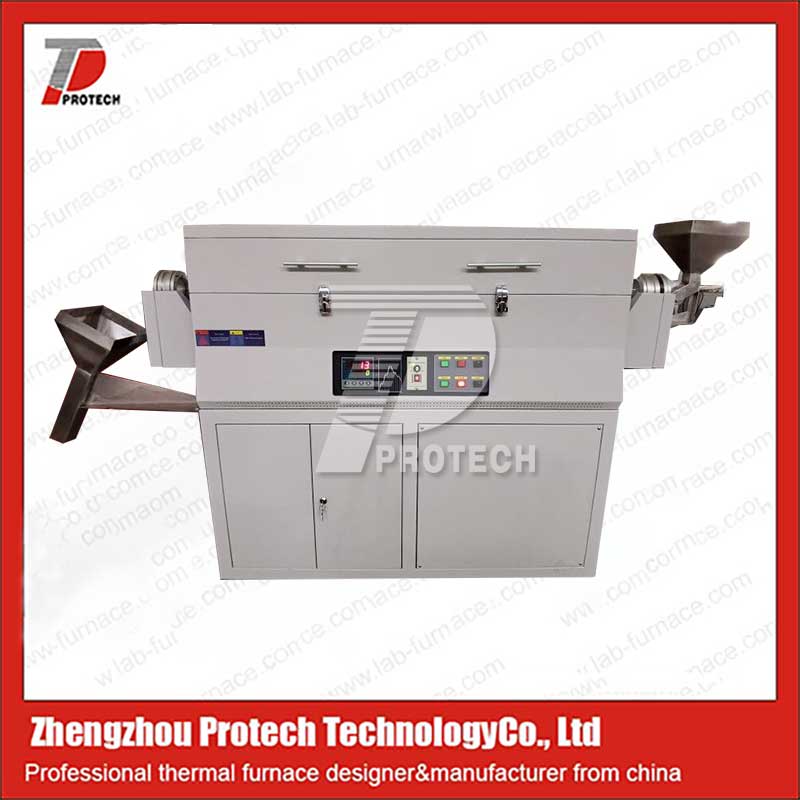
Commonly used rotary tube furnace (click on the image to view product details)
1. What is a rotary tube furnace? What is the working principle?
The rotary tube furnace is different from ordinary fixed tube furnaces in that its core feature is that the furnace tubes can rotate at low speed. Some models support 0-30 ° electric tilt adjustment and are equipped with a variable frequency drive system, allowing for flexible speed adjustment. Working Principle:
The motor drives the high-temperature resistant furnace tube to rotate at a constant speed, and the powder and granular materials continuously roll and lift inside the furnace tube. Each particle of powder can fully contact the heat source and process atmosphere; By adjusting the inclination angle and speed of the furnace tube, the residence time of the material in the high-temperature zone can be controlled, which can achieve both intermittent batch sintering and a complete continuous heat treatment process of feeding heating insulation discharging.
The equipment supports various process environments such as vacuum, inert atmosphere, oxidation, and reduction, and can complete various heat treatment processes such as powder calcination, sintering, crystal transformation, decarburization and gel removal, CVD coating, and pyrolysis.
2. Compared to static furnaces, rotary tube furnaces have core process advantages
Traditional box type furnaces and ordinary horizontal tube furnaces have poor thermal conductivity due to powder accumulation and static heating, which can lead to surface overburning and internal undercorning, poor consistency of finished products, and easy agglomeration of ultrafine powder at high temperatures. In the later stage, secondary crushing and processing are also required. The dynamic heating mode of the rotary tube furnace specifically addresses these pain points:
Powder is heated more evenly
The continuous rolling and flipping of materials eliminates the temperature gradient caused by accumulation, reduces the temperature difference between material particles, reduces the performance deviation of sintered products, has good batch reproducibility, and is suitable for new material experiments and mass production with high consistency requirements.
Effectively inhibit powder agglomeration and agglomeration
In the state of dynamic agitation, the powder will not be compacted and piled up for a long time, which will greatly reduce the high temperature agglomeration and hard agglomeration of nano powder and lithium powder, and reduce the post-treatment crushing process.
Gas solid reaction is more complete
The powder keeps flipping, and the surface of the particles is repeatedly exposed to the atmosphere, increasing the contact area between the gas and the powder. The reduction, oxidation, and doping coating reactions are more complete, improving the process efficiency.
Support both intermittent and continuous production modes
Intermittent rotary tube furnace is suitable for university scientific research and new material formula debugging. Each batch can freely modify temperature, atmosphere, and speed parameters; The continuous rotary tube furnace is equipped with a feeding and discharging mechanism, which operates 24 hours a day without stopping for cooling and unloading, meeting the needs of large-scale production.
Easy to operate and clean
The tilting function allows for direct unloading, reducing the need for repeated removal and placement of crucibles and ceramic boats. It also simplifies the cleaning of residue on the tube wall and reduces the labor intensity of experimental production.
Attention: Rotary tube furnaces are more suitable for loose and flowable powders and granular materials; Not suitable for fragile and irregular block shaped workpieces. For block shaped samples, ordinary tube furnaces and muffle furnaces are preferred for processing.
3. The main application industries and materials of rotary tube furnace
The rotary tube furnace focuses on dynamic sintering of powders and continuous heat treatment, covering many fields such as university laboratories, new material enterprises, new energy, chemical catalysis, powder metallurgy, etc.
(1) The new energy materials industry
Calcination and coating sintering of lithium positive and negative electrode materials, lithium iron phosphate, ternary materials, silicon carbon negative electrode, and solid electrolyte powder; The modification treatment of photovoltaic powder materials is a commonly used heat treatment equipment in the pilot production of lithium battery new materials.
(2) Advanced ceramics and inorganic powders
Calcination of structural ceramic powders such as silicon nitride and silicon carbide, sintering of electronic functional ceramic powders, and crystal transformation treatment of rare earth oxide and nano oxide powders.
(3) Catalysts, chemical materials
Molecular sieve, activated alumina carrier loading, carbon nanotube, graphene doping modification, dehydration, degumming, and thermal decomposition treatment of various powder materials.
(4) Powder metallurgy and metal powders
Metal powder reduction sintering, heat treatment of refractory metal powder, annealing treatment of magnetic powder, powder synthesis preparation is completed under vacuum or protective atmosphere.
(5) Research Institute Laboratory
Research and development of new material formulas in the School of Materials Science and Chemical Engineering Laboratory, dynamic sintering tests of small batch powder samples, flexible switching of temperature, atmosphere, and speed parameters, and exploration of process conditions.
4. How to choose between intermittent and continuous rotary tube furnaces?
Many users cannot distinguish between intermittent and continuous rotary tube furnaces, and simply distinguish the applicable scenarios:
Intermittent rotary tube furnace
Suitable for R&D sampling, multi formula debugging, and small batch materials ranging from grams to kilograms; Each batch can modify the heating curve and atmosphere parameters, and the process is flexible. It is mainly used in the laboratory and small-scale testing stage.
Continuous rotary tube furnace
Suitable for fixed materials and stable mass production; Automatic feeding and discharging, uninterrupted continuous heat treatment, high production capacity; The disadvantage is that frequent material replacement requires shutdown to clean the furnace, and the debugging cost is high. It is mostly used in pilot and industrial production lines.
5. What parameters should be considered when selecting a rotary tube furnace?
Maximum operating temperature: Based on the selection of powder sintering process temperature, distinguish between extreme temperature and long-term stable use temperature;
Furnace tube materials: quartz tube, corundum tube, high-temperature resistant alloy tube, different materials are suitable for different temperatures and atmospheres;
The adjustment range of speed and tilt angle directly determines the residence time of the material;
Atmosphere and vacuum capability: whether vacuum is required, and which process gases such as nitrogen, argon, hydrogen need to be introduced;
Temperature control system: independent temperature control in multiple temperature zones, programmable temperature rise curve, temperature control accuracy;
Capacity demand: Intermittent models are selected for small-scale trials, and continuous feeding and discharging structures are prioritized for large-scale production.

Industrial production rotary tube furnace (click on the picture to view product details)
6. Summary
Simply put, a rotary tube furnace is a dynamic heat treatment equipment designed specifically for powder materials. Its core value is dynamic sintering, which solves the problems of uneven heating and agglomeration of powders, and balances intermittent experiments and continuous heat treatment production.
If your process object is powder or granular materials, and you have been troubled by poor consistency of static furnace sintered products for a long time, then rotary tube furnace is a very suitable heat treatment equipment; If it is a block shaped workpiece, ordinary tube furnace or box type muffle furnace should be preferred.Click to learn more rotary tube furnaces! Or click on online customer service to learn more about product information!
Leave A Message


