
 English
 简体中文
简体中文 French
 日本語
日本語 Korean
 Português
 Русский
 Spanish



NEWS
The sintering of powders such as lithium iron phosphate, ternary positive electrode, and silicon carbon negative electrode in lithium batteries has always faced challenges such as particle adhesion, agglomeration, uneven heating, and uneven batch quality of finished products under high temperatures. Traditional fixed tube furnaces and box type muffle furnaces allow powder to accumulate in a static manner, resulting in pressure on the bottom layer of the powder, high local temperatures, and abnormal grain growth. This can easily lead to hard agglomeration and agglomeration, directly reducing the cycle life and ion conductivity of battery materials.
As a specialized heat treatment equipment for new energy powder sintering, the multi zone rotary tube furnace relies on multiple structural designs such as zone temperature control, dynamic material flipping, atmosphere control, and speed regulation to reduce powder sintering agglomeration from the root. Below, we will provide a detailed breakdown of the entire anti agglomeration working principle, hardware configuration, and process techniques for lithium battery research and development personnel and factory procurement personnel to refer to and select.
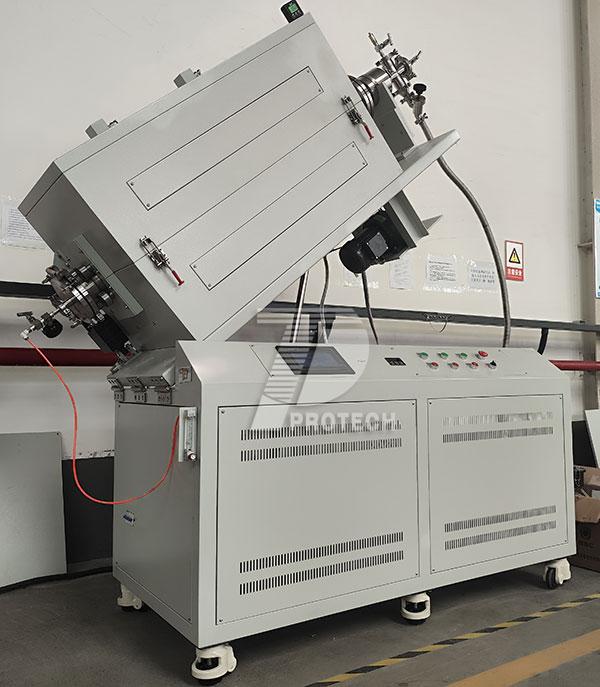
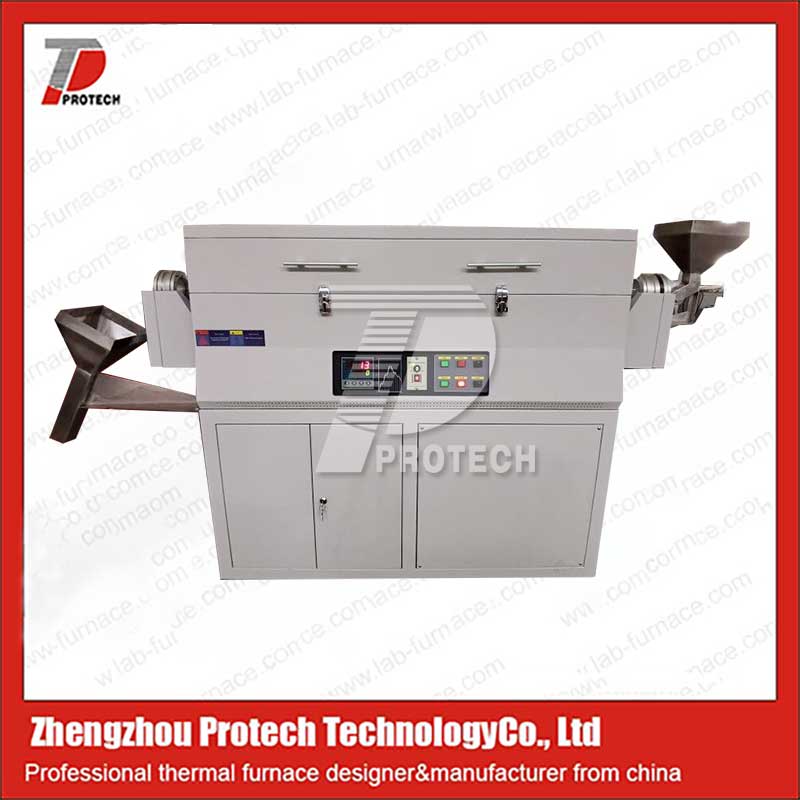
Atmosphere Rotating Tube Furnace (Click on the picture to view product details)
1. The main causes of powder sintering agglomeration
To prevent agglomeration, it is necessary to first understand the causes of battery powder agglomeration:
Uneven heating: During static sintering, the powder accumulates, and there is a large temperature difference between the surface, middle, and bottom layers, resulting in local overheating. The surface material of the particles melts and adheres together, forming hard lumps;
Reaction gas retention: The precursor decomposes at high temperatures to produce water vapor and organic waste gas. The internal exhaust of the accumulated powder is blocked, and liquid-phase bridging promotes powder bonding;
Grain agglomeration during cooling stage: Heating up to sintering high temperature in one go, uncontrolled growth of particles; The cooling rate is unreasonable, and the powder adheres to each other for a long time under high temperature conditions;
Uneven distribution of protective atmosphere: Inert gas can only contact the surface of the material, and the oxygen content of the internal powder is unstable, resulting in impurities that promote particle adhesion.
2. Four core anti caking mechanisms for multi temperature zone rotary tube furnace
(1). The furnace tube dynamically rolls and lifts the material, breaking up the bottom pressure of powder accumulation
The equipment is equipped with a variable frequency speed control rotating transmission component, and quartz and corundum material furnace tubes can rotate uniformly 360 °. A fixed lifting plate is installed on the inner wall of the furnace tube.
During the operation, the powder is shoveled, thrown, and flipped, and all particles are constantly changing their positions. There is no underlying material that accumulates under long-term pressure. The powder particles are in a loose fluidized state, which avoids the bonding caused by accumulation and compression from a physical perspective. The rotational speed can be infinitely controlled according to the powder particle size of 0-20r/min; The fine nano powder is selected with low rotating speed, and the large particle powder is adjusted with high rotating speed to prevent dust from rolling too violently.
(2). Segmented independent multi zone gradient heating to avoid local overheating, melting, and agglomeration
A multi temperature zone rotary tube furnace is generally divided into three or more independent temperature control zones: preheating and degassing zone, constant temperature sintering zone, and slow cooling zone. Each temperature zone is equipped with an independent thermocouple and PID temperature control module, and the temperature control error can be controlled within ± 1 ℃.
Preheating zone: Slowly raise the temperature at low temperature, fully discharge the crystallization water, binder, and volatile organic compounds inside the precursor, and timely release the exhaust gas, so as not to be trapped inside the powder and form liquid phase adhesion;
Sintering constant temperature zone: The powder rolls through the high-temperature sintering section, and the overall temperature field is uniform, without local overheating. The grain grows uniformly, preventing excessive grain growth and mutual adhesion;
Post cooling temperature zone: Powder gradient cooling, avoiding prolonged contact between particles in high temperature environments, and suppressing soft agglomeration during the cooling stage.
Gradient temperature control separates the sintering process, which can significantly reduce the probability of hard agglomeration of battery powder compared to a single temperature zone with one-time heating.
(3). Flowing protective atmosphere, taking away sintering waste gas to optimize powder environment
The two ends of the furnace tube adopt wear-resistant dynamic sealing structure to ensure the airtightness of the furnace under rotating conditions. Protective gases such as nitrogen and argon are continuously introduced into the furnace, accompanied by the rolling of the powder. The airflow can penetrate all the gaps of the powder, timely carrying away the water vapor and corrosive volatiles produced by sintering decomposition.
Adequate inert atmosphere can also isolate oxygen and prevent the oxidation of positive electrode materials to produce impurities, which are also important triggers for powder agglomeration; For the process of sintering lithium iron phosphate in low oxygen environment and ternary materials with oxygen enrichment, it is also possible to adjust the intake flow ratio to adapt to production standards.
(4). Adjustable tilt angle controls the residence time of the powder, providing more accurate control over sintering time
The inclination angle of the furnace body supports manual and electric adjustment. Adjusting the inclination angle can control the speed of powder movement, thereby controlling the duration of powder residence in the high-temperature sintering zone.
When the sintering insulation time is too long, the grains are prone to adhere and agglomerate with each other; The residence time is too short and the crystal development is incomplete. By relying on the inclination angle and furnace tube speed, the high-temperature residence time of each particle can be more accurately controlled, and the sintering conditions for all particles are unified, resulting in uniform grain size of the powder and reducing the probability of agglomeration.
3. Practical points for anti caking corresponding to different battery powders
Lithium iron phosphate positive electrode powder: low-speed rolling, slow heating in three temperature zones, strict control of furnace oxygen content during sintering stage to prevent agglomeration caused by Li-P impurities;
High nickel ternary material: By introducing a high-purity oxygen atmosphere, the heating rate slows down, the lifting plate gently flips, reducing dust and electrostatic agglomeration of ultrafine powders;
Silicon carbon negative electrode coating sintering: Strictly control the highest sintering temperature, remove resin binders in multiple temperature zones, dynamically roll to ensure uniform carbon coating layer, and avoid carbon layer adhesion and agglomeration between particles.
4. Summary of Selection
Simply put, the multi temperature zone rotary tube furnace relies on four core designs: dynamic flipping to break up and stack materials, zone gradient temperature control to prevent local overheating, flow atmosphere to discharge exhaust gas, and controllable material retention time. It solves the problem of high-temperature agglomeration of lithium battery powder from three dimensions: physical environment, temperature curve, and sintering atmosphere.
Nowadays, a large number of new energy laboratories and powder processing plants have eliminated the static sintering box bowl process and selected multi temperature zone rotary tube furnaces to complete the calcination and sintering processing of battery materials. The equipment supports non-standard customization of furnace tube material, temperature zone quantity, lifting structure, and atmosphere system.
Conclusion
Powder agglomeration has always been a key pain point that restricts the electrochemical performance of lithium batteries. Compared to ordinary tube furnaces, the dynamic sintering mode of multi temperature zone rotating tube furnaces is suitable for various positive and negative electrode powder processes, and can stably produce loose, uniform grain, and low agglomeration battery raw materials. When manufacturers purchase equipment, they can focus on examining temperature control accuracy, rotational transmission stability, and rotational position sealing performance, and customize exclusive equipment parameters to match their own powder particle size.Click to learn more rotary tube furnaces! Or click on online customer service to learn more about product information!
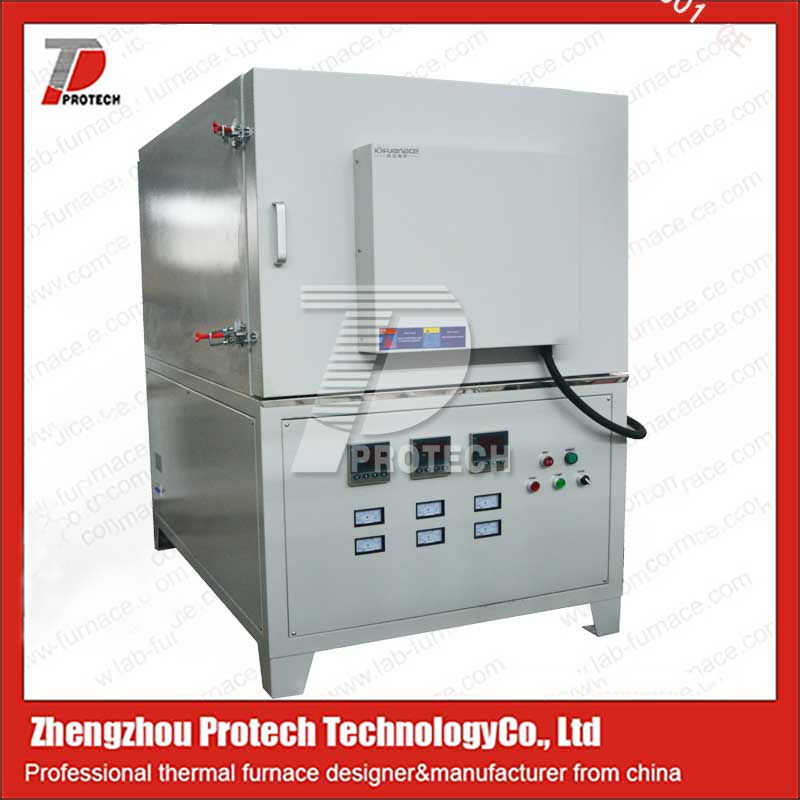
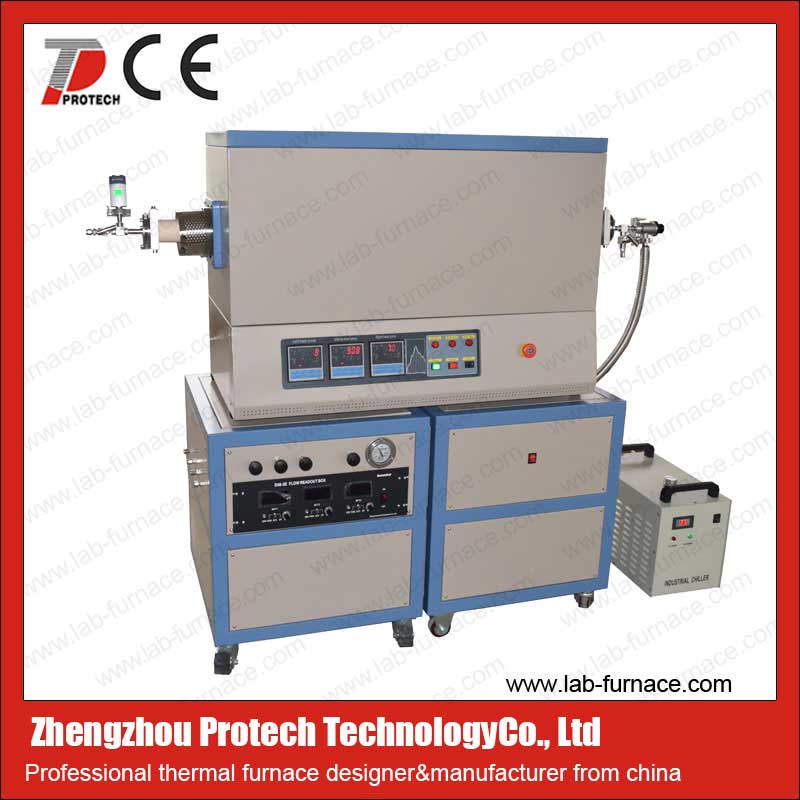
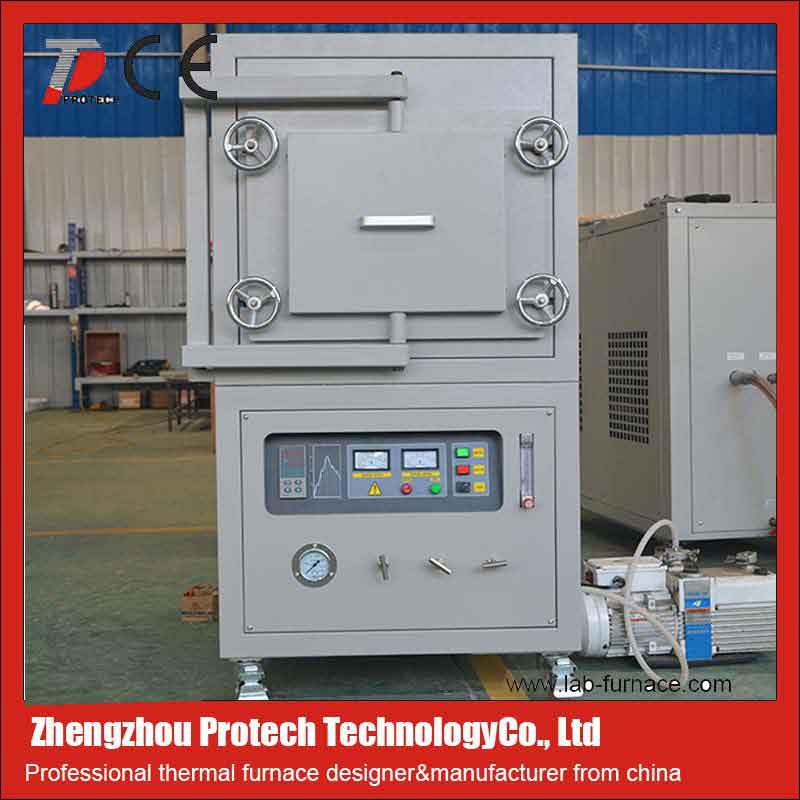
Leave A Message


