
 English
 简体中文
简体中文 French
 日本語
日本語 Korean
 Português
 Русский
 Spanish



NEWS
In the industries of powder sintering, solid-phase synthesis, catalyst calcination, and new material heat treatment, rotary tube furnaces rely on the rotation of furnace tubes to flip materials, solving pain points such as material accumulation, local overheating, uneven heating, and powder agglomeration in ordinary tube furnaces. They have become standard heat treatment equipment in university laboratories, research institutes, and new material factories.

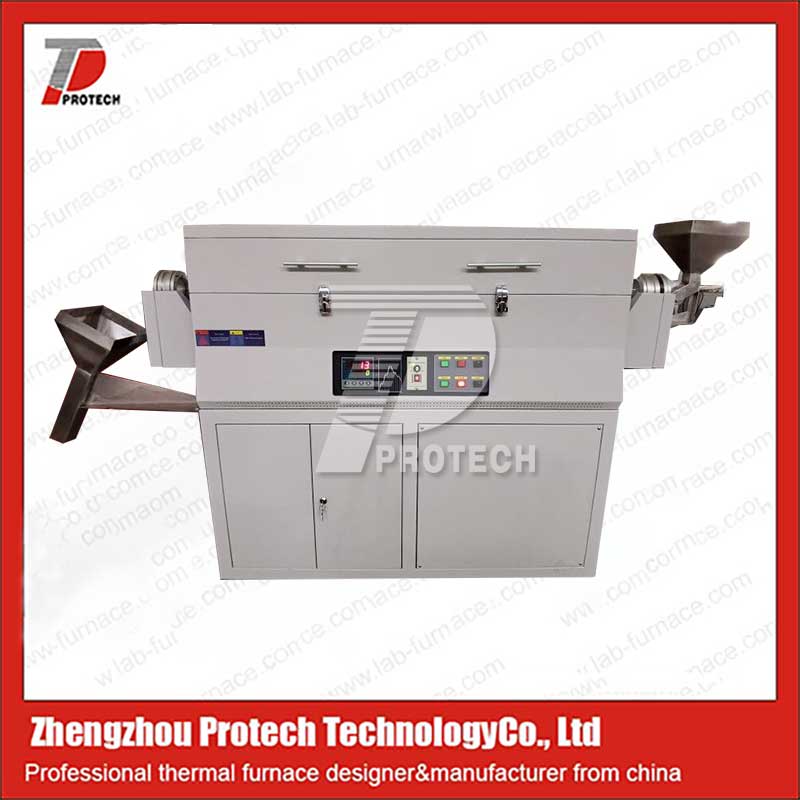
A commonly used small indirect rotary tube furnace (click on the image to view product details)
According to the feeding and discharging working mode, the mainstream is divided into two categories: intermittent rotary tube furnace and continuous feeding and discharging rotary tube furnace. Many procurement personnel cannot distinguish the difference between the two, often resulting in poor process adaptation, insufficient production capacity, high energy consumption, and frequent parameter changes that delay production due to scientific research procurement of mass production equipment and factory selection of experimental models.
Below is a detailed comparison of the working principle, core advantages and disadvantages, segmented usage scenarios, material adaptation, and complete selection guide, to facilitate R&D personnel and factory managers to quickly select suitable models.
1. Working principles of two types of rotary tube furnace foundations
(1) Intermittent rotary tube furnace (batch type)
Intermittent type belongs to single batch cyclic operation, and the entire process is manual material loading → closed furnace, setting heating and insulation cooling program → low-speed rotation heating reaction of furnace tube → after the entire process is completed, the machine is stopped for cooling, the finished product is taken out, and then the next batch of processing is started.
Each heat treatment cycle is independent, and the heating curve, speed, tilt angle, and atmosphere can be changed at any time. The process parameters between batches do not interfere with each other, and are mostly used for the development of small batch samples.
(2) Continuous feeding and discharging rotary tube furnace
The equipment is equipped with an automatic feeding mechanism, a spiral feeding port, and a discharge collection device; The furnace tube maintains a constant inclination angle and rotates at a constant speed. Powder particles continuously flow in from the feed end and slowly pass through the heating zone, insulation zone, and cooling zone under the rotation and rolling. The finished product is continuously discharged from the discharge end.
The equipment can operate continuously 24/7 without the need for shutdown, cooling, and unloading. The entire temperature field environment is stable for a long time, and it focuses on large-scale production and processing.
2. Detailed comparison of advantages and disadvantages between intermittent and continuous rotary tube furnaces
| Compare dimensions | Intermittent rotary tube furnace | Continuous feeding and discharging rotary tube furnace |
| Process flexibility | Very high, each batch can change temperature, atmosphere, speed, and adapt to multiple formula debugging | Fixed process curve, frequent material switching requires shutdown to clean the furnace, high debugging cost |
| Single processing scale | Small batch samples, gram kilogram materials | Large quantities of powder, suitable for stable processing of raw materials every day |
| Energy consumption performance | Each round requires heating and cooling, resulting in high heat storage loss and long-term processing energy consumption | The furnace operates at a constant temperature without repeated start stop, making it more energy-efficient compared to intermittent models |
| Heating uniformity | By relying on the rolling of the furnace tube, the sample is heated evenly, making it suitable for exploring better flipping parameters | The material is transported forward at a constant speed, and all raw materials have the same dwell time, resulting in strong consistency in the quality of large-scale products |
| Equipment investment cost | The body is compact, the structure is simple, the procurement budget is low, and it is easy to place in the laboratory | Equipped with feeding and discharging components, multi zone temperature control, PLC control system, higher purchase cost, and larger footprint |
| Automation level | Mostly used for manual loading and unloading, suitable for scientific research experiments | Fully automatic feeding and discharging, capable of 24-hour unmanned production |
| Cleaning and maintenance | Cleaning the furnace during material replacement is convenient and not prone to material cross contamination | After long-term mass production, residues are prone to adhere to the inner wall of the pipe, and the process of replacing processing materials and cleaning is cumbersome |
3. Detailed explanation of scene adaptation: How to choose between research and development, pilot testing, and mass production?
(1) Scenario where intermittent rotary tube furnace is preferred
a. New material research and development in university laboratories and research institutes
The School of Materials Science, Chemical Engineering Laboratory, and Rare Earth Research Institute of universities require large-scale formula testing on a daily basis, adjusting different heating rates, insulation durations, nitrogen/argon/hydrogen reduction atmospheres, and furnace tube speeds.
Intermittent models can test more than ten sets of sample parameters within a day during each independent operation; The equipment is compact in size and easy to replace with quartz and corundum tubes, making it a priority for the research and development of lithium battery powder, ceramic raw materials, and catalyst carriers.
b. Multi category, small batch customized processing enterprises
Some new material processing factories have scattered orders and often take turns processing zirconia powder, molecular sieves, metal powders, negative electrode coating materials, and mineral activation materials.
When frequently switching processing materials, intermittent equipment cleaning is simple, and there is no need to worry about residue causing material pollution; The tilt angle can be adjusted at any time to deal with special powders with poor fluidity and easy wall sticking and agglomeration.
c. Strict special process, long-term insulation sintering process
Some ceramic precursors and high-temperature alloy powders require insulation reactions lasting several hours to over ten hours. After the intermittent furnace is closed, the entire environment becomes stable, allowing for long-term insulation and constant pressure. Continuous feeding equipment finds it difficult to control the prolonged residence time of materials.
d. Sample making, customer sample customization, small-scale trial to pilot phase
The product is in the experimental stage, with unstable output and an undeveloped process, making it unsuitable for large-scale continuous production lines; Intermittent rotary tube furnace is used to complete pilot tests, and after determining mature processes, continuous mass production equipment is upgraded to avoid equipment investment risks.
4. Reference for selection of various processing materials
Catalysts, molecular sieves, and adsorbent materials: intermittent research and development for new products; Continuous activation roasting is used for large-scale activation;
Advanced ceramic powders, zirconia, barium titanate: intermittent furnace for formula debugging, continuous feeding and discharging furnace for mature powder mass production;
Lithium ion positive and negative electrodes, lithium iron phosphate, coated carbon powder: intermittent equipment for small-scale use, and continuous rotating tube furnace standard for industrial production lines;
Rare earth powder and high-purity metal powder: preferably intermittent to reduce cross contamination of different batches of raw materials;
Kaolin and bentonite mineral powder activation: The material has excellent flowability and is suitable for continuous long-term batch calcination.
5. Complete selection and pit avoidance guide for rotary tube furnace
(1) Select furnace accessories based on working temperature
Stainless steel furnace tubes are selected for temperatures ≤ 1000 ℃; Suitable for quartz tubes at 1000-1350 ℃; High temperature sintering above 1350 ℃ is preferred for corundum alumina furnace tubes; The high-temperature reducing atmosphere should avoid ordinary quartz pipes to prevent corrosion and loss.
(2) Confirm the atmosphere and environment in advance
Ordinary ventilation structure is selected for oxidation sintering; Inert protection, hydrogen reduction, vacuum sintering process, selection of dynamic rotating sealing structure to prevent gas leakage during furnace tube rotation, resulting in powder oxidation and scrap.
(3) Furnace tube speed and inclination angle parameters
Scientific research experiment suggests that the speed can be infinitely adjusted from 0 to 20r/min; Poor flowability and easy wall sticking of powder, increase the rotational speed; The control of material retention time is adjusted by a 0-30 ° tilt angle.
(4) Temperature control system configuration
R&D equipment prioritizes temperature rise instruments with 30 or more segments, supporting temperature rise, insulation, and cooling curve storage; Industrial continuous furnaces select multi zone independent temperature control models to ensure independent and controllable temperatures in the feeding zone, high-temperature sintering zone, and cooling zone.
6. Summary
A simple summary of the selection formula: choose intermittent for multiple formula trials, and continuous for mature mass production.
Intermittent rotary tube furnace focuses on flexible and low-cost sample processing, suitable for university laboratories, new material research and development, and multi category small orders; The continuous feeding and discharging rotary tube furnace focuses on high-efficiency and stable batch heat treatment, which is suitable for industrial production after the process is finalized.
When purchasing, comprehensive consideration should be given to the types of materials, daily processing capacity, atmosphere conditions, and temperature parameters. Alternatively, the electric furnace manufacturer can be contacted to customize the equipment according to the process.Click to learn more rotary tube furnaces! Or click on online customer service to learn more about product information!
Leave A Message


