
 English
 简体中文
简体中文 French
 日本語
日本語 Korean
 Português
 Русский
 Spanish



NEWS
1. What is PECVD tube furnace?
PECVD tube furnace, also known as plasma enhanced chemical vapor deposition tube furnace, is a precision experimental equipment that combines plasma discharge technology with high-temperature heat treatment process. Unlike traditional CVD tube furnaces, PECVD tube furnaces rely on radio frequency power to generate plasma, activate reaction gases at lower temperatures, and complete processes such as material surface coating, thin film deposition, surface modification, etching, doping, etc. Due to its low deposition temperature, good film uniformity, and strong process controllability, it is widely used in fields such as semiconductors, optical materials, nanomaterials, new energy, and university research laboratories.
At present, PECVD tube furnaces on the market are mostly horizontal structures, integrating vacuum systems, RF plasma systems, gas path control systems, and intelligent temperature control systems. They are the core scientific research equipment for preparing silicon nitride, silicon oxide, graphene, and diamond-like carbon films.

Commonly used slide PECVD electric furnace (click on the image to view product details)
2. Main structural components of PECVD tube furnace
a. Tube furnace heating system
The furnace body adopts an integrated high-temperature resistant furnace structure, matched with alumina insulation fiber, with good insulation performance, and the shell is not hot to the touch at low temperatures. The heating element adopts good resistance wire or silicon carbide rod, with stable heating and uniform temperature field. High purity quartz tubes are generally used as furnace tubes, which have good transparency, high temperature resistance, and strong airtightness, and will not cause impurity pollution to the plasma deposition process.
b. Plasma RF Generation System
RF power supply is the core component of PECVD tube furnace. By high-frequency discharge, the process gas inside the tube is ionized to form a uniform plasma, reducing the activation energy of chemical reactions and achieving low-temperature deposition. The system can adjust the power level, control the plasma concentration, and adapt to different film deposition thicknesses and density requirements.
c. High vacuum sealed system
The equipment is equipped with a combination of mechanical pumps and molecular pumps, which can achieve a high vacuum environment and effectively eliminate air, water vapor, and impurity gases inside the tube. The two ends of the furnace tube are equipped with stainless steel flanges and silicone sealing structure, which has strong sealing performance, prevents air backflow, ensures oxygen free and clean deposition process, and improves film purity and adhesion.
d. Precision pneumatic control system
Equipped with multiple high-precision quality flow meters, it can better control the flow of process gases such as methane, ammonia, silane, argon, nitrogen, etc. The gas pipeline is made of anti-corrosion stainless steel material, which is corrosion-resistant and resistant to high pressure. It supports single channel ventilation and multi channel mixed ventilation, meeting the proportioning requirements of various vapor deposition processes.
e. Intelligent electrical control system
Adopting a touch screen PLC intelligent control system, with built-in multi-stage heating curves, temperature, RF power, intake flow rate, and vacuum pressure can all be visually adjusted. The device comes with data storage, curve export, and abnormal alarm functions. Experimental data can be traced, making it suitable for scientific research records and paper data collection.
3. Core structural characteristics of PECVD tube furnace
a. Low temperature deposition, without damaging the substrate
By relying on plasma to excite chemical reactions without the need for high temperature environments, the conventional deposition temperature is controlled between 200 ℃ -1100 ℃. High temperature resistant substrates, flexible materials, and optical lenses can be coated without deformation, carbonization, or damage to the substrate.
b. The film is uniform and dense, with strong adhesion
The plasma distribution inside the tube is uniform, the gas reaction is sufficient, the generated film thickness is uniform, the surface is dense, and there are no pinholes. The film has strong adhesion with the substrate, is not easily detached, and exhibits excellent insulation, corrosion resistance, and transparency.
c. Flexible craftsmanship and wide compatibility
By adjusting RF power, temperature, gas ratio, and vacuum degree, different materials of thin films can be prepared, including silicon oxide, silicon nitride, carbon film, graphene film, metal film, etc., which are suitable for material research and development in multiple industries.
d. Safe and stable, with high experimental reproducibility
The equipment is equipped with multiple safety interlocks such as anti backfire, anti leakage, over temperature power-off, and water pressure protection. Accurate temperature control, stable plasma output, and high experimental consistency under the same process parameters are very suitable for long-term scientific research in universities and formula debugging in enterprises.
4. Precautions for selection of PECVD tube furnace
a. Clarify experimental temperature and deposition requirements
Before selecting, it is necessary to confirm the temperature range required for the experiment. Conventional low-temperature sedimentation is selected for models with temperatures below 600 ℃; If high-temperature annealing+deposition composite process is required, it is recommended to choose a high-temperature resistant tube furnace with a maximum temperature of 1200 ℃. Simultaneously distinguish the requirements for film thickness and deposition rate, and match them with corresponding RF power models.
b. Pay attention to the vacuum sealing performance
The vacuum degree directly determines the purity of the film. It is recommended to choose a high vacuum configuration for scientific research experiments, with a vacuum degree of 10 ⁻ Pa level; Low vacuum economical equipment can be used for ordinary modification experiments. Prioritize the use of thickened flanges and double-layer sealing structures to avoid long-term air leakage that may affect experimental results.
c. Select furnace tube specifications based on sample size
The diameter of the furnace tube determines the number and size of samples placed at a time. Common pipe diameters are 50mm, 80mm, 100mm, and 120mm. Large pipe diameters are selected for batch samples, while small pipe diameters are selected for micro experiments to avoid space waste and high energy consumption.
d. Does the RF power configuration meet the standard
RF power supplies are divided into domestic and imported configurations. It is recommended to use a high stability RF power supply for high-precision coating and ultra-thin film preparation. The plasma distribution is more uniform, the discharge is flicker free, and the experimental error is smaller.
e. Is the gas path configuration compatible with the process gas
Corrosive gases and flammable and explosive gases require dedicated anti-corrosion gas circuits and anti backfire devices. Ordinary inert gases can use basic gas path structures. When selecting, it is necessary to inform the manufacturer in advance of the type of gas used to avoid pipeline corrosion and safety hazards.
f. Manufacturer's after-sales and customization capabilities
PECVD tube furnace belongs to precision scientific research equipment, and later maintenance, component replacement, and process debugging are crucial. It is recommended to choose the source manufacturer, which supports non-standard customized pipe diameter, temperature zone, gas path, RF system, and provides technical guidance, installation and commissioning, and lifelong after-sales service.
5. PECVD tube furnace application industry
-Semiconductor industry: chip coating, insulation film, passivation layer preparation;
-Optical materials: anti reflective film, protective film, and anti-oxidation film for optical lenses;
-New energy materials: battery electrode modification, separator coating, conductive film;
-University research: experimental research and development of nanomaterials, two-dimensional materials, and graphene;
-Precision hardware: deposition of wear-resistant film and anti-corrosion film on metal surfaces.

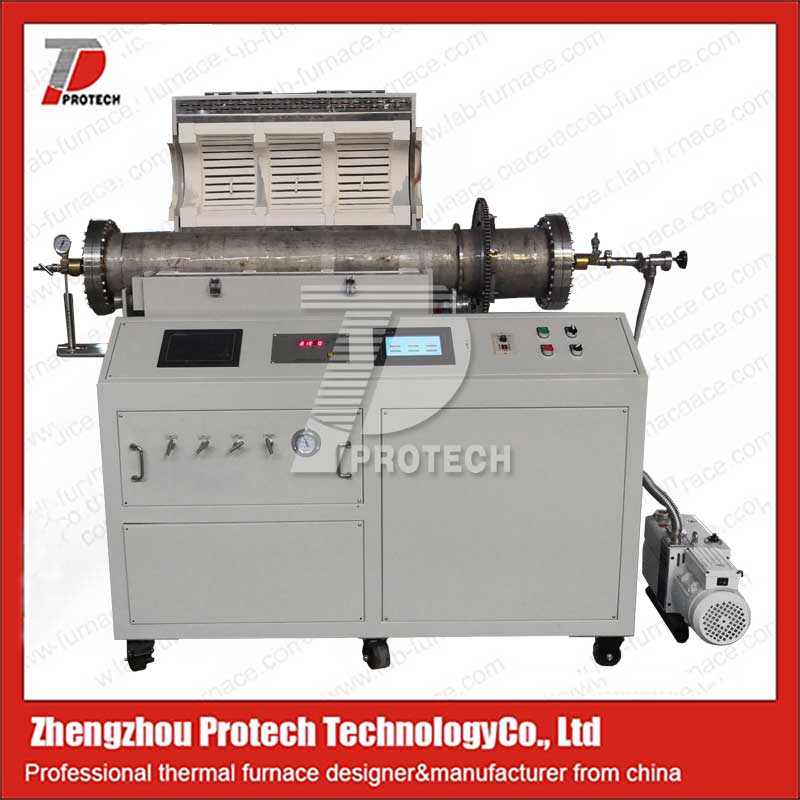
PECVD tube furnace that can rotate and tilt (click on the image to view product details)
6. Summary
PECVD tube furnace has become a commonly used deposition equipment for new material research and development due to its advantages of low-temperature deposition, plasma activation, uniform thin film, and rich process. When selecting equipment, users need to pay close attention to furnace structure, vacuum configuration, RF system, gas path compatibility, and manufacturer customization capabilities. Reasonable selection can not only improve the success rate of experiments, but also reduce long-term usage costs.
Protech's specializes in the production of PECVD tube furnaces, vacuum tube furnaces, and high-temperature experimental furnaces. It supports non-standard customization and can customize RF power, pipe diameter, temperature, and gas path solutions according to experimental requirements. The quality is guaranteed by the source manufacturer. Welcome to consult for equipment parameters and quotations.Click to learn more customized PECVD electric furnaces! Or click on online customer service to learn more about product information!
Leave A Message


